
When your fibre broadband service is disconnected, reconnection policies and costs can vary depending on your provider. Here's a quick overview of how Chorus, Spark, and One NZ handle reconnections:
Chorus: Manages the physical fibre network but doesn’t charge reconnection fees directly. Fees are set by your Retail Service Provider (RSP). Reconnection timelines depend on the issue, with remote activations being faster than physical repairs or upgrades like Hyperfibre.
Spark: Charges a $43.50 reconnection fee for non-payment suspensions. Technician-related fees may apply if no fault is found. Reconnection is quick if your ONT is active, but local capacity may limit service restoration.
One NZ: Doesn’t advertise a fixed reconnection fee. Additional charges may apply for technician visits, overdue payments, or complex setups. Reconnection timelines depend on ONT status and technician availability.
Quick Comparison:
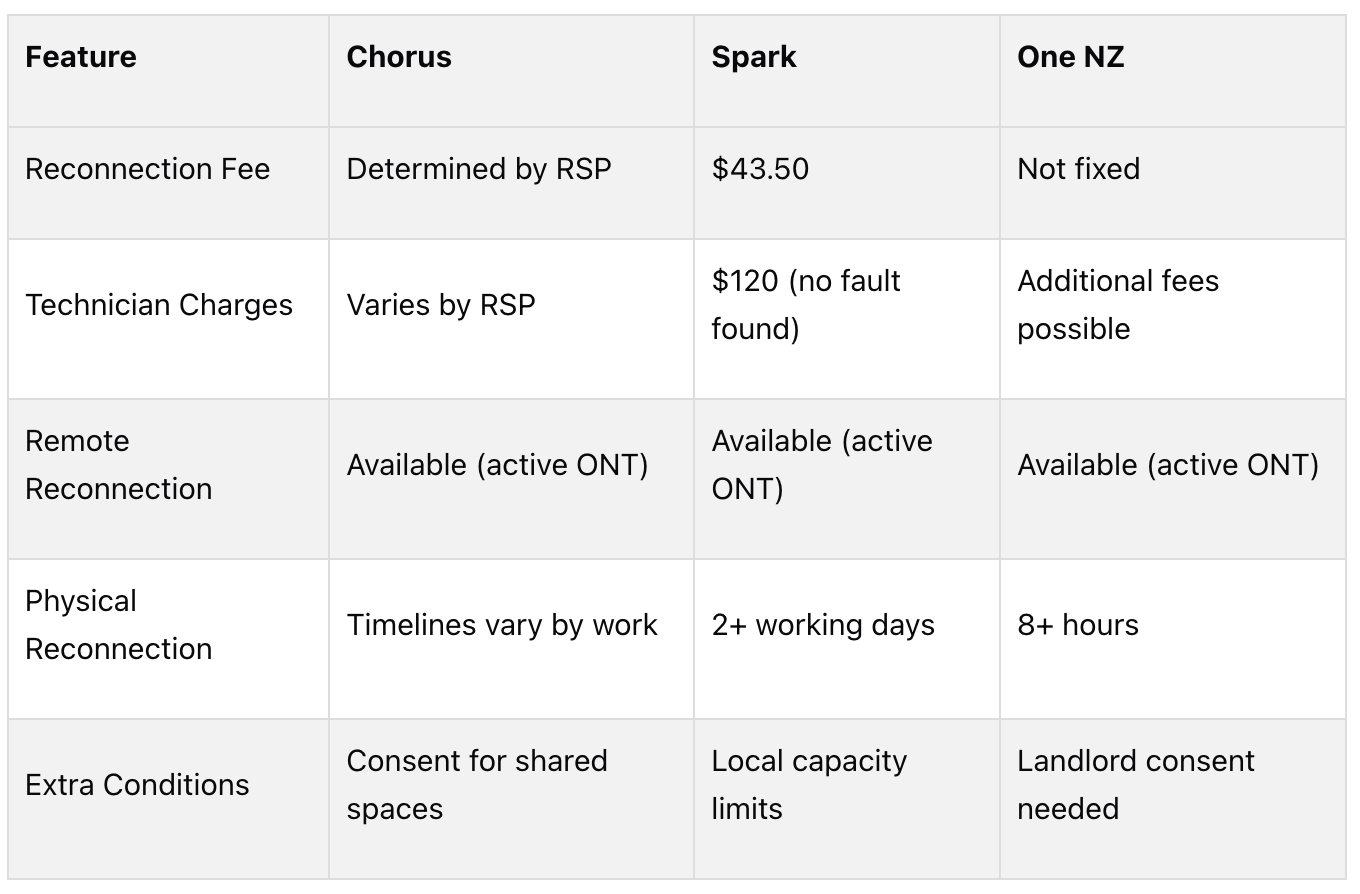
Each provider has different processes, fees, and conditions, so it’s essential to understand their policies to avoid delays or unexpected costs. Keep reading for more details on how each provider operates.
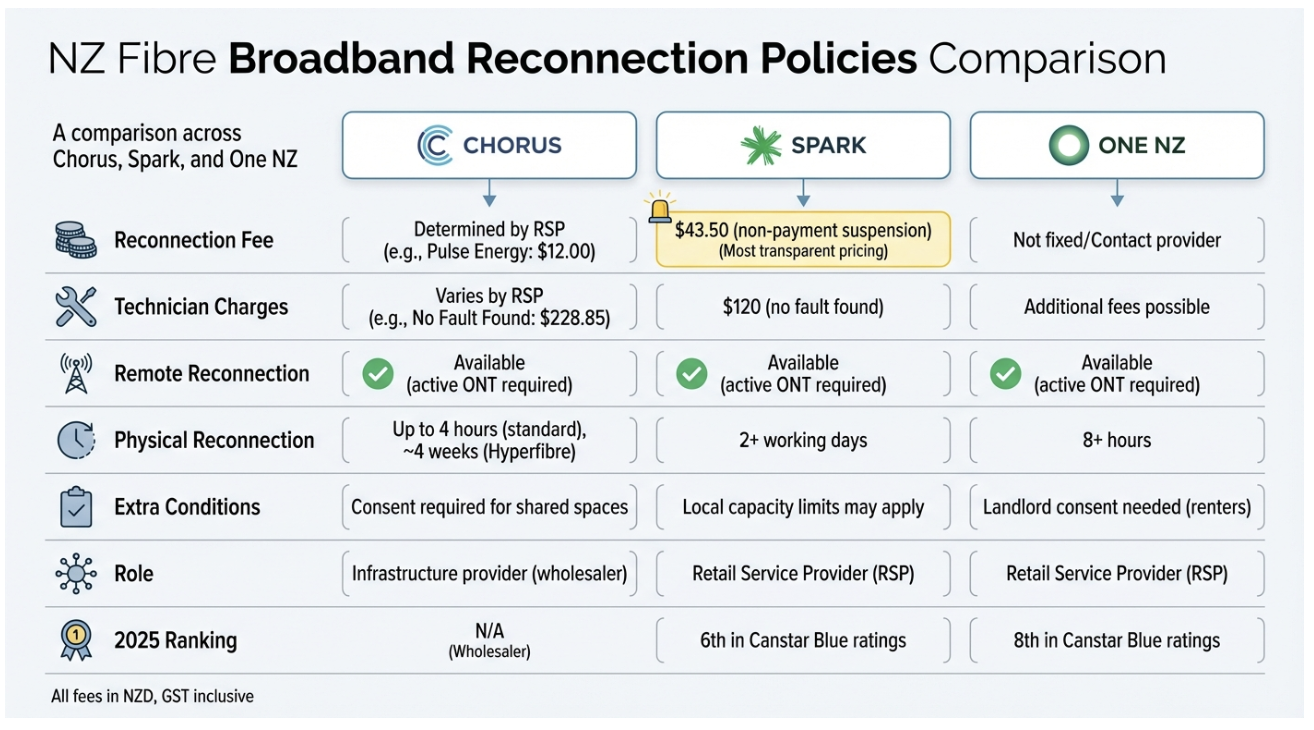
NZ Fibre Reconnection Fees and Policies Comparison: Chorus vs Spark vs One NZ
1. Chorus
Chorus serves as the Local Fibre Company (LFC) for most of New Zealand, except in areas like Whangarei, Christchurch, and the Central North Island [2]. While Chorus manages the physical fibre network, tasks like billing and reconnection are handled by your Retail Service Provider (RSP). That said, Chorus's policies play a key role in determining how quickly and efficiently your service can be restored. Here’s a closer look at reconnection fees, timelines, and service conditions under their network.
Reconnection Fees
Chorus itself doesn’t charge reconnection fees. Instead, the cost is determined by the RSPs operating on its network. For instance, Pulse Energy charges a $12.00 (GST inclusive) "Unblocking Fee" for broadband services on the Chorus network [7]. If physical work is required - like relocating equipment or repairing damage you’ve caused - Chorus allows you to pay directly via credit card for services such as "Network Relocate" or "Misc Network Services" [11].
It’s also worth noting that if a technician is called out and no network fault is found, some RSPs impose significant charges. For example, Pulse Energy’s "No Fault Found Fee" is $228.85 (GST inclusive) [7]. Knowing these potential costs can help you better understand how fees are structured within the Chorus network.
Reconnection Timelines
When it comes to timelines, the process varies depending on the situation. If your Optical Network Terminal (ONT) is already installed and powered, your RSP can often restore your connection remotely [8]. For physical restorations, Chorus follows a three-stage process: Agree, Build, and Connect. The final "Connect" stage usually involves a technician visit, which can take up to 4 hours [9].
More complicated upgrades, such as Hyperfibre installations, may take around 4 weeks to complete [5]. Before reaching out for reconnection, it’s a good idea to check the Chorus Internet Outages Map to see if there’s an active fault in your area and when it’s expected to be resolved [10].
Service Restoration Conditions
For most service issues or disconnections, your first point of contact should always be your RSP, as Chorus requires this [10]. If you live in a multi-unit property, a cross-lease, or a right-of-way property, Chorus will need formal consent from all affected property owners before they can start restoration work [10].
Avoid moving any Chorus equipment yourself, as this could damage the fibre network and result in extra repair costs. Instead, request a "Network Relocate" if you need equipment moved [10][11]. Additionally, if you’ve misplaced the power cable for your fibre box, Chorus offers free replacements, which they’ll courier to you at no charge [10].
2. Spark
Spark is a Retail Service Provider (RSP) operating on New Zealand's fibre networks. This means they manage billing, customer service, and reconnection requests. Unlike Chorus, which handles the physical infrastructure, Spark focuses on customer-facing aspects like payments and service restoration. While Spark ranked 6th in the 2025 Canstar Blue "Most Satisfied Fibre Broadband" ratings [6], they offer straightforward reconnection processes. Here's a breakdown of what to expect when reconnecting with Spark.
Reconnection Fees
If your service is suspended due to non-payment, Spark charges a $43.50 reconnection fee [4]. For cases where a technician visit is required, you could face a $120 diagnostic fee if no network fault is found or if the issue stems from your own equipment [1][4].
Additional charges may apply for specific services:
ONT extension: $199
Relocation within your property: $249
Integrated wiring: $69 site visit fee plus $79 wiring fee [4]
Standard fibre installations are generally free for residential properties. However, if you cancel after confirming an installation date, a cancellation fee may apply [1].
Reconnection Timelines
For properties with an already installed and powered Optical Network Terminal (ONT), Spark can usually restore your connection remotely [8]. Switching to a new plan generally takes up to two working days [1]. More advanced upgrades, such as Hyperfibre, can take approximately four weeks due to the additional network adjustments required [5].
However, reconnection to the same broadband type isn't guaranteed after disconnection. Spark notes that capacity constraints in your area could prevent you from resuming your previous service [1]. During installation or restoration, you might experience a temporary landline outage, though this is typically resolved within a few hours [1][4].
Service Restoration Conditions
Before Spark can restore your service, certain conditions must be met:
Your ONT must be plugged in and display a solid green "Power" light [8].
If technician access is needed, you must provide property access; otherwise, the service may be cancelled [1].
It's crucial to notify Spark if you rely on medical dependency alarms or monitored home alarms, as these may need specific configurations during fibre reconnection [12]. For those living in shared spaces like apartments or Right of Way properties, neighbour or landlord consent is required before fibre installation or restoration can proceed [9].
Lastly, keep in mind that fibre services depend on mains power. During power outages, your connection will not function unless you're registered as a "Vulnerable Consumer" [1][4].
3. One NZ
One NZ, like Chorus and Spark, has a structured approach to reconnection processes. As a Retail Service Provider (RSP), it delivers fibre broadband services throughout New Zealand and handles customer billing and service management. In the 2025 Canstar Blue "Most Satisfied Fibre Broadband" ratings, One NZ secured 8th place [6]. Their reconnection policies include specific fees and conditions that customers should be aware of.
Reconnection Fees
One NZ doesn't advertise a fixed reconnection fee but may apply charges or conditions during suspension or reconnection periods [14]. The standard fibre installation cost is $199, though this is often waived for customers on 12-month, 24-month, or open-term contracts [13]. Customers are required to settle any overdue charges, and late payments may result in additional fees [14]. If a technician visit is necessary and no network fault is found, or if the issue stems from customer equipment, extra charges may apply. There’s also a $14.95 fee for modem postage and handling, and more complex setups - like properties with multiple phone lines - may incur additional installation costs [13].
Reconnection Timelines
For premises with an active ONT (Optical Network Terminal), One NZ typically restores service remotely [8]. However, new installations requiring a technician can take about 8 hours and will need onsite access. After installation, there’s a 7–10 day speed optimisation period, during which customers are advised not to reboot their modem [15]. The exact timing can vary depending on the policies and availability of the Local Fibre Company (LFC) involved [15].
Service Restoration Conditions
To restore service, One NZ requires customers to pay all outstanding charges in full. A credit check is also mandatory, and renters must provide written consent from their landlord [14][15]. Customers must comply with the terms and conditions set by their specific LFC, and technician access to the premises is essential - failure to provide access may lead to service cancellation [14]. Vulnerable customers are encouraged to inform One NZ ahead of time, as fibre services depend on mains power [15]. If disconnection occurred due to unpaid charges, any remaining debt could be referred to a collection agency [14].
Pros and Cons
The reconnection policies of each provider influence both the cost and the time it takes to restore service. Here’s a breakdown of the key points:
Chorus operates as the wholesaler managing the fibre network, but reconnection speeds depend on the retail provider you select. For standard plans up to 1 Gbps, they excel with remote activation, which typically doesn’t require a technician visit[16]. However, upgrading to Hyperfibre involves replacing the ONT (Optical Network Terminal), which can significantly delay the process. The reconnection fees are determined by your chosen retail provider.
Spark offers quick service restoration for existing ONTs and charges a fixed reconnection fee. However, reconnection may be limited by local capacity if the disconnection was due to non-payment[1]. Clearing any outstanding balance is a prerequisite for restoring service[4]. These policies highlight Spark’s focus on balancing cost with efficient restoration.
One NZ doesn’t provide clear information about a fixed reconnection fee, which can create uncertainty about costs. Additional charges may apply for non-standard setups, such as technician visits[2]. Customers are also required to return all hardware, like modems or SIMs, to avoid extra fees[2]. Understanding these conditions can help you weigh your options and choose the provider that aligns with your connectivity needs.
Conclusion
Here's a quick recap of the key points from each provider's reconnection policy:
Spark charges a straightforward $43.50 reconnection fee once you clear your outstanding balance [4]. This clear pricing makes it easier to plan financially after a temporary disconnection.
Chorus, as the main infrastructure provider for much of New Zealand's fibre network, doesn't handle reconnections directly. Instead, retail service providers manage this process, which means outcomes can vary. If you're upgrading to Hyperfibre, check whether an ONT upgrade is required, as this could add extra steps [16].
One NZ recommends contacting them directly for the most up-to-date reconnection fees and any potential additional charges.
It's also worth noting a few important tips:
Check your contract's end date to avoid early termination fees and confirm that your address supports the speed tier you need [17].
Under the Consumer Guarantees Act, you can cancel your contract without penalty if there's a price increase during a fixed term [17][3].
For disputes related to reconnection or billing, the Telecommunications Dispute Resolution (TDR) scheme offers a free and independent service [18].
When comparing options, it's clear that Spark's $43.50 fee provides a predictable solution for households needing simple and transparent reconnection costs. However, the best choice depends on your household's internet usage, budget, and whether bundling options might offer additional value [17].
FAQs
How can I tell if my ONT is still active?
To see if your Optical Network Terminal (ONT) is active, find the device - typically a white or black box with an optical port - and check the power indicator light. A solid green light signals that it’s powered on and active. If the light is off or flashing red, ensure it’s properly connected to a working power outlet. If the issue persists, you may need to contact your internet provider for help.
What extra fees might apply if a technician finds no fault?
If a technician finds that the issue isn't with the fibre infrastructure, you could be charged a No Fault Found Fee of $199. This often happens when the problem is traced to things like internal wiring or router issues. The fee applies when a reported fault turns out to be unrelated to the fibre network.
What should I do first if I’m disconnected for non-payment?
If your service has been disconnected due to non-payment, settle the overdue amount straight away using your preferred payment method, such as a debit/credit card or bank transfer. Once you've made the payment, take a screenshot of the confirmation and email it to accounts@nownz.co.nz to request reconnection.
If you've already made the payment within the last 48 hours, ensure you include proof of payment in your email. Keep in mind that payments made outside of support hours could result in delays, as reconnections may only occur during regular banking hours.