
Rural vs Urban Fibre: Coverage Comparison NZ
The digital divide between rural and urban New Zealand is clear: urban areas enjoy widespread fibre internet coverage, while rural regions face slower, costlier options. Here's what you need to know:
Urban fibre coverage: 87% of the population is covered under the Ultra-Fast Broadband (UFB) programme, reaching 412 towns and cities. Average speeds hit 300 Mbps, with options up to 1,000 Mbps.
Rural connectivity: Only 9.8% of New Zealand's landmass benefits from fibre. Many rural homes still rely on copper (9 Mbps average) or wireless/satellite options like Starlink (150+ Mbps).
Cost gap: Rural copper plans cost $28/month more than the OECD average, despite slower speeds.
Government efforts: Programmes like the Rural Broadband Initiative (RBI) and Rural Capacity Upgrades are improving access with hybrid solutions (e.g., fibre backhaul, 4G/5G), but challenges remain.
Quick Comparison
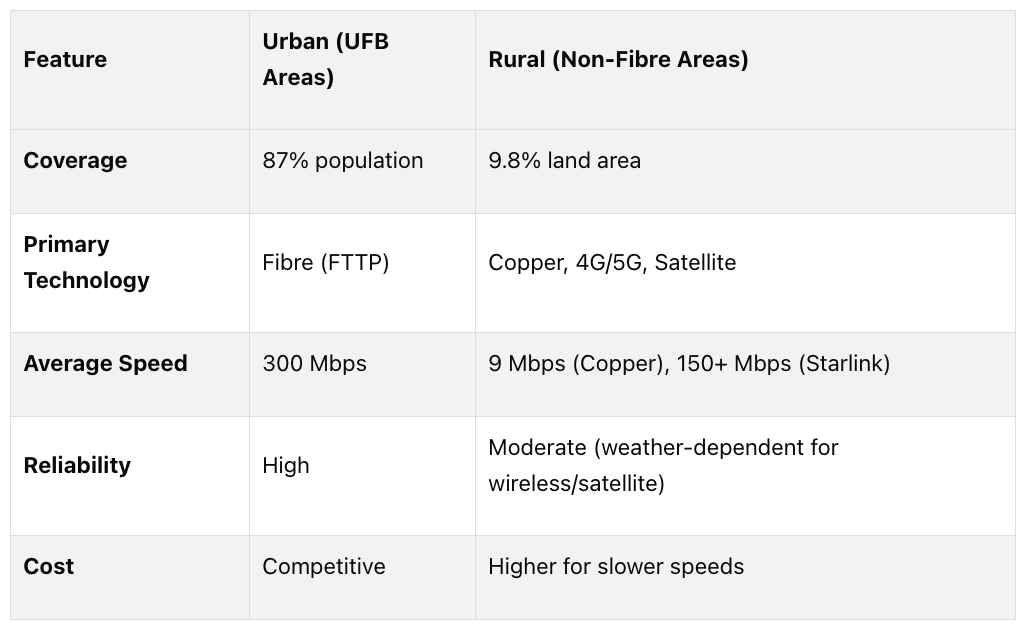
Urban areas thrive on high-speed, reliable fibre, while rural regions face slower, less stable options. Efforts to bridge this gap are ongoing, but disparities persist, impacting everything from remote work to rural business operations.
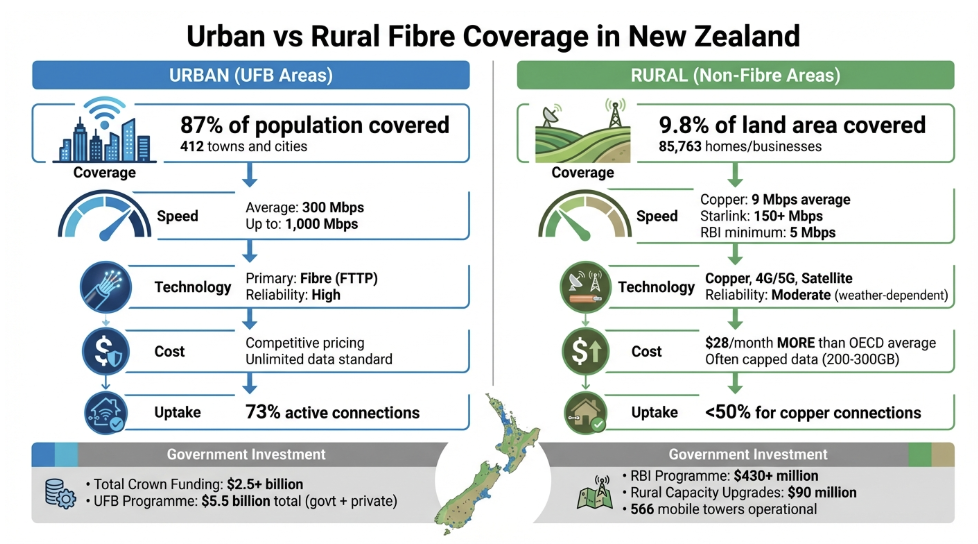
Urban vs Rural Fibre Internet Coverage in New Zealand: Key Statistics Comparison
Fibre Coverage in Urban New Zealand
Ultra-Fast Broadband (UFB) Programme in Cities and Towns
By December 2022, New Zealand's Ultra-Fast Broadband (UFB) programme had successfully delivered fibre-to-the-premises (FTTP) to 412 towns and cities, including smaller communities like Haast, Ōwhango, Tuatapere, and Eketāhuna [9][10]. This ambitious project, with a total cost of NZ$5.5 billion, was funded through a mix of NZ$1.75 billion in government interest-free loans and NZ$3.75 billion from private sector contributions [9].
Urban fibre infrastructure is managed by four main players: Chorus, covering major hubs like Auckland, Wellington, Dunedin, and Hamilton; Enable Networks, serving Christchurch; Tuatahi First Fibre, operating in Hamilton, Tauranga, and New Plymouth; and Northpower Fibre, which focuses on Whangārei [11]. By the end of 2024, fibre adoption had reached 76% of premises, highlighting strong uptake in cities and towns [9].
““The UFB network is designed and future-proofed for growth. Consumers can already buy 8 Gbps services to the home and with future optical technology, upgrade speeds and capacity are largely unconstrained.” – National Infrastructure Funding and Financing [9]”
This robust network has become critical as household data consumption has soared, with the average monthly usage now around 650GB - a staggering 13-fold increase over the past decade [9]. Many urban areas have been designated as Specified Fibre Areas (SFAs), where fibre is so widely available that copper-based services are being phased out. Since the first assessment in 2019, SFAs have expanded by 29.7% as of January 2026 [3]. This extensive coverage has paved the way for more competitive pricing and a wider range of service options.
Access and Pricing in Urban Areas
The UFB infrastructure has significantly enhanced affordability and service diversity in urban New Zealand. Residents benefit from competitive, open-access pricing offered by multiple providers [9][12]. Pricing structures are typically based on speed tiers, with unlimited data plans being the standard. For those looking to save, capped data plans are available at slightly lower rates [12].
Thanks to the network's forward-thinking design, urban households can seamlessly upgrade to higher speeds without the need for major infrastructure changes. Over the years, speeds have progressed from 100 Mbps to multi-gigabit options, keeping pace with modern demands like streaming, remote work, and cloud-based services. This adaptability ensures that the network continues to meet the growing data needs of New Zealanders.
Fibre Coverage in Rural New Zealand
Obstacles to Rural Fibre Deployment
Expanding fibre networks into rural parts of New Zealand isn't easy. The combination of sparse populations and rugged landscapes drives up the cost per connection, making such projects financially impractical for many providers [5]. Remote regions often present physical challenges, as laying fibre-optic cables through complex terrain can be both time-consuming and expensive [5].
““While highly populated areas of New Zealand have been provided with very high-quality broadband through the UltraFast Broadband programme, locations with lower population density and complex geography have not all been able to be serviced by market providers.” – National Infrastructure Govt NZ [5]”
Adding to these difficulties, severe weather events in 2023 disrupted deployment schedules, creating further delays [4]. In response, various initiatives have been developed to address the unique needs of rural communities.
Rural Broadband Initiative (RBI) Progress
The Rural Broadband Initiative (RBI) has adopted a hybrid approach, combining fibre-optic and cellular technologies to bring broadband to areas where the UltraFast Broadband (UFB) programme isn't feasible [6][7]. To support this effort, the government has allocated more than $430 million from the Telecommunications Development Levy [7].
Phase 1 of the RBI, completed in June 2016, upgraded 1,200 Chorus cabinets, allowing 110,000 rural households to access improved fixed-line broadband. It also connected over 1,000 schools and 39 healthcare facilities to fibre [7]. By early 2024, the initiative had enhanced broadband access for approximately 85,763 rural homes and businesses, covering 26,326 square kilometres, or about 9.8% of New Zealand's land area [4].
The Rural Connectivity Group (RCG) - a collaboration between Spark, One NZ, and 2degrees - has been instrumental in rolling out 4G fixed-wireless services. By early 2024, 566 mobile towers were operational under the programme, with a 44% uptake rate on RCG towers. Recent additions include towers at Aickens (West Coast), Lake Heron (Canterbury), Mangaorapa (Hawke's Bay), and Maruia Springs (West Coast), completed in early 2024 [4].
Further investments include the $47 million Rural Capacity Upgrade introduced in February 2022 to reduce network congestion for 47,000 rural households. This was later expanded with an additional $43 million from Budget 2022, extending coverage to another 26,000 premises [7]. Despite these advancements, many rural areas continue to rely on alternative internet solutions.
Other Internet Options for Rural Areas
For rural New Zealanders without fibre access, several alternatives are available. RBI fixed wireless (4G/5G) technology, delivered via cell towers, offers improved speeds compared to outdated copper lines. However, it requires a clear line of sight to the nearest tower for optimal performance [15][16]. Currently, around fifteen regional Wireless Internet Service Providers (WISPs) partner with the government to enhance rural connectivity [4].
For those near fibre-fed cabinets, VDSL over copper can deliver speeds exceeding 100 Mbps, while older ADSL connections typically range from 7.5 to 24 Mbps. However, speeds drop significantly - often below 5 Mbps - when distances exceed 6 km [14][15]. Both technologies are gradually being phased out as fibre and wireless networks expand [15].
Satellite internet is another option for remote locations where ground-based infrastructure isn't available. While it offers broad coverage, it requires a clear view of the sky, and obstacles like trees or buildings can disrupt the connection [8]. For the most isolated areas, the Remote Users Scheme, launched in November 2022, provides connectivity support through Crown Infrastructure Partners [6][7].
To check available options and coverage plans, rural residents can visit the National Broadband Map at www.broadbandmap.nz. This tool helps users identify providers and compare planned versus actual coverage for their specific address [4][7].
Coverage Statistics: Urban vs Rural
Coverage Rates and Fibre Pass-By Numbers
The data paints a clear picture of New Zealand's ongoing efforts - and challenges - in closing the digital divide. While the Ultra-Fast Broadband (UFB) fibre optic network now reaches 87% of the population across 412 towns and cities, 13% of New Zealanders remain outside its reach [13][17].
As of 30 June 2025, 73% of the premises within UFB coverage areas had active fibre connections [13]. On the other hand, the Rural Capacity Upgrade programme has extended fibre broadband to over 5,600 rural households and businesses, showcasing some progress in rural connectivity [13]. However, the disparity is stark when considering land area: urban fibre covers the majority of population centres, while the Rural Broadband Initiative serves only 9.8% of New Zealand's landmass. This initiative has improved broadband access for approximately 85,763 rural homes and businesses [4]. The table below highlights the distinct contrasts between urban and rural areas.
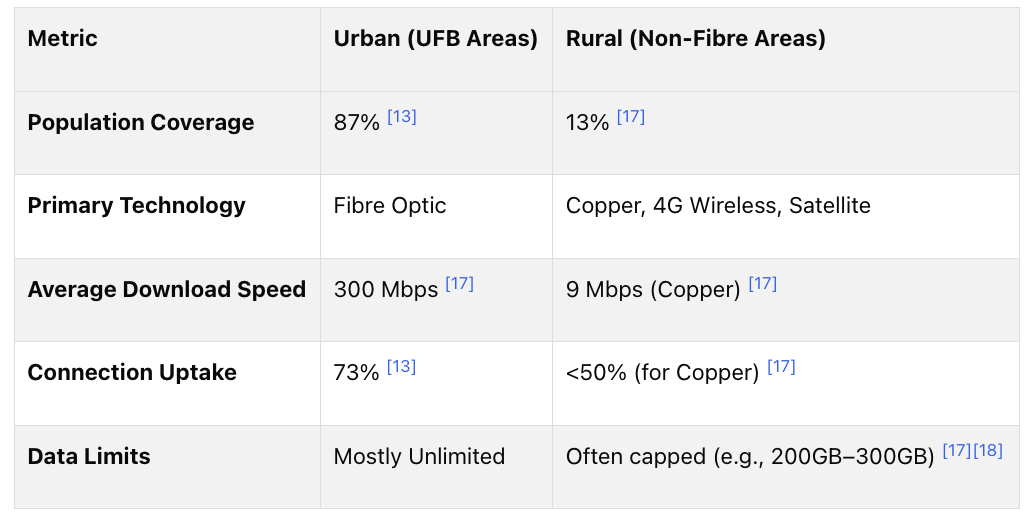
The price-to-performance gap further highlights the disparity. As Commissioner Tristan Gilbertson points out, rural copper connections, which average just 9 Mbps, cost roughly the same as urban fibre plans offering 300 Mbps. This has pushed many rural users to switch to wireless and satellite options, with copper connection uptake now below 50% [17]. These numbers underline the stark differences in speed, reliability, and affordability between urban and rural broadband services.
Speed and Reliability Comparison
Typical Speeds: Urban vs Rural
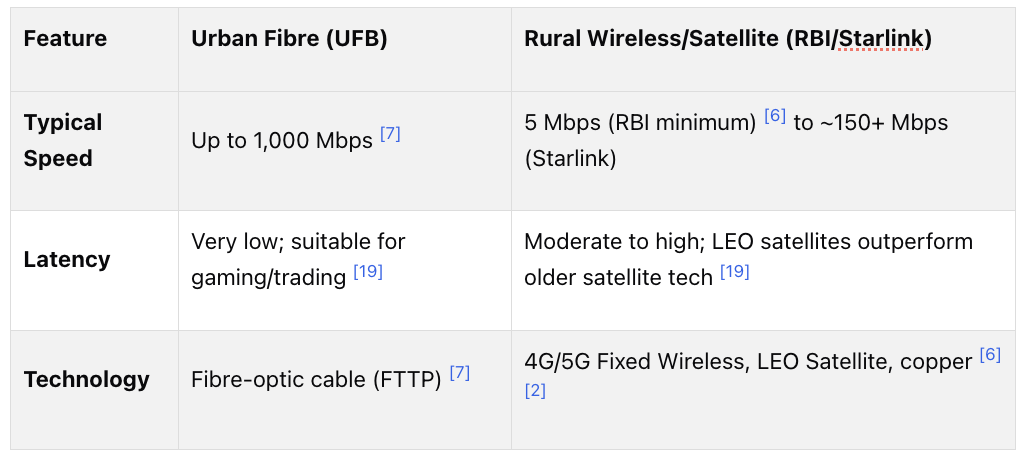
Speed disparities between urban and rural internet connections in New Zealand significantly affect user experience. Urban areas with Ultra-Fast Broadband (UFB) enjoy speeds of up to 1,000 Mbps [7], while rural regions, under the Rural Broadband Initiative (RBI), are guaranteed a minimum of 5 Mbps for over 90% of homes and businesses outside UFB zones [6].
““Because Ultra-Fast Broadband (UFB) isn’t feasible for every rural community, peak broadband speeds of at least 5Mbps is being provided to more than 90% of homes and businesses outside UFB areas.” – New Zealand Telecommunications Forum [6]”
However, rural connectivity is evolving quickly. Low Earth Orbit (LEO) satellite services like Starlink are shaking up the market, offering speeds that are three times faster than other rural options [2].
““Starlink is delivering speeds three times faster than other rural alternatives and consumers are voting with their feet – making Starlink the fastest growing rural broadband provider.” – Telecommunications Commissioner Tristan Gilbertson [2]”
These differences highlight the ongoing challenges in bridging the urban-rural internet divide.
Connection Reliability and Uptime
When it comes to reliability, urban fibre connections stand out. Fibre infrastructure is largely immune to environmental disruptions, providing consistent uptime for users.
““For users who value a stable, predictable connection above all else, this structural resilience often makes fiber more reliable day to day.” – Tech Times’ Renz Soliman [19]”
Rural connections, on the other hand, face unique challenges. Wireless and satellite technologies are more vulnerable to weather-related disruptions, as satellite signals require a clear view of the sky [8]. Additionally, rural mobile towers are more prone to damage during extreme weather events [4]. These issues, combined with slower speeds, underscore the connectivity gap between urban and rural areas. Recent government initiatives to upgrade rural infrastructure aim to address congestion and improve reliability [7].
Government Programmes Closing the Connectivity Gap
Government initiatives have played a key role in reducing the digital divide between urban and rural areas in New Zealand. With more than $2.5 billion in Crown funding invested across various programmes, the government has made significant strides in improving connectivity [20]. The Ultra-Fast Broadband (UFB) programme, which primarily focused on urban regions, had reached 87% of the population by December 2022. Meanwhile, rural programmes have been tailored to meet the unique challenges posed by lower population densities [7].
One of the cornerstone initiatives for rural areas is the Rural Broadband Initiative (RBI), which received over $430 million from the Telecommunications Development Levy. This funding has enabled the extension of high-speed broadband to more than 84,000 households and businesses where installing fibre-to-the-premises would be too costly [7]. Instead of relying solely on fibre connections, the RBI utilises a combination of fibre backhaul and cellular technology.
““Traditionally, fibre broadband is better suited to higher density areas as the cost of running long lengths of fibre past widely spaced properties and down long driveways in rural areas had made fibre not as viable as other broadband options.” – National Infrastructure Funding and Financing [13]”
“Newer government efforts have shifted towards direct fibre deployments in rural areas. The Rural Capacity Upgrades (RCU) programme, backed by $90 million in funding, is bringing full fibre networks to rural households for the first time [7]. This initiative, which involves seven partners rolling out the infrastructure, represents a significant change in strategy. By deploying fibre directly, the programme aims to provide rural communities with faster and more reliable internet, moving away from the reliance on wireless solutions [13].
In addition to these efforts, the government has invested in strategic fibre links to improve connectivity in some of the country’s most remote regions. For example, the West Coast Fibre Link, completed in March 2022, stretches 247 kilometres along State Highway 6 and provides backhaul support for 19 mobile towers, connecting remote settlements like Haast [13]. Similarly, the Southland Fibre Link, finished in May 2023, runs 118 kilometres from Te Anau to Milford Sound, supporting 11 mobile towers and serving tourism operators in the area [13]. These projects were made possible through the reinvestment of $390 million from returned UFB loan repayments, further boosting rural connectivity [9].”
Regional Examples: Coverage Differences Across New Zealand
Case Study: Auckland vs Southland
The contrast in connectivity between urban and rural areas becomes striking when you compare Auckland to Southland. In Auckland, 87% of homes and businesses are covered by the UFB network[13]. This gives residents access to a range of speed options, from 300 Mbps to multi-gigabit plans[8].
In Southland, fibre efforts are more targeted, focusing on essential locations like mobile towers and tourism hubs. Recent fibre installations have improved connectivity for critical services and tourism operators, but widespread coverage remains limited[13].
For most Southland residents, connectivity depends on alternatives like 4G Fixed Wireless, satellite services such as Starlink, or ageing copper lines. Starlink, in particular, has emerged as a game-changer, offering speeds up to three times faster than traditional rural options and becoming the fastest-growing broadband provider in these areas[2]. Despite these advancements, the gap in connectivity remains stark, especially for businesses.
How Connectivity Affects Small Businesses
The uneven rollout of fibre impacts more than just households - it significantly affects the operations of local businesses. In Auckland, urban companies enjoy high-speed fibre that supports activities like cloud computing, video conferencing, and transferring large files without bandwidth concerns. These capabilities allow businesses to operate efficiently and stay competitive.
In contrast, rural businesses in Southland face tougher decisions. They often have to choose between expensive copper lines, unreliable wireless connections, or high-latency satellite services. However, there are bright spots. For instance, the Milford Sound fibre link has been a lifeline for tourism operators in one of the most remote areas of New Zealand. This connection enables real-time booking systems, seamless payment processing, and effective communication with guests, which are critical for their operations[13].
Outside these strategically connected areas, rural businesses must rely on what's available - whether that's a mobile tower, line-of-sight wireless, or satellite. Unfortunately, these options often fall short, leaving them at a disadvantage compared to their urban counterparts.
Conclusion
Urban areas in New Zealand boast impressive fibre coverage, reaching 87%, but the picture is quite different for rural communities, where 37% still rely on slower and more expensive copper connections [1][2]. While city dwellers enjoy fibre speeds of up to 300 Mbps, rural copper lines average a mere 9 Mbps. Even with Starlink offering speeds three times faster than typical rural options, the gap remains significant [2][17]. On the bright side, the Rural Broadband programme has already improved connectivity for over 85,763 rural homes and businesses [4].
““The telecommunications market in New Zealand has reached a major milestone in urban areas with the successful completion of the UFB roll-out... attention is now on closing the connectivity gap in rural areas” – Telecommunications Commissioner Tristan Gilbertson [2]”
This stark contrast between urban and rural connectivity highlights the pressing need for customised solutions across the country. Whether you’re in Auckland or Southland, your internet speed depends heavily on what’s available in your area. To find the best option for your address and budget, visit fibredeals.co.nz and explore plans from 94 different providers [21].
FAQs
Why is fibre internet coverage better in urban areas compared to rural areas in New Zealand?
The gap in fibre internet coverage between urban and rural New Zealand boils down to three key factors: population density, cost, and geography. Urban areas, with their concentrated populations, are far more practical for fibre network rollouts. These cities and towns often already have infrastructure in place, which makes installation easier and more affordable.
Rural areas, on the other hand, face a completely different set of challenges. Populations are more spread out, the terrain can be rugged, and the cost per household to install fibre skyrockets. These hurdles make it less appealing for providers to invest heavily in building networks in these regions. Government programmes like the Rural Broadband Initiative (RBI) are working to improve rural connectivity, but progress tends to be slower due to the logistical and environmental complexities involved.
That said, efforts to close this gap continue, with alternative technologies and focused initiatives helping to bring better internet access to rural communities.
What challenges make it harder to expand fibre networks to rural areas in New Zealand?
Expanding fibre networks across rural New Zealand isn’t without its hurdles. For starters, the geography of these areas often includes rugged terrain and remote locations. This makes laying down infrastructure both technically challenging and costly. On top of that, the low population density in these regions means fewer customers, which can dampen the financial motivation for providers to invest heavily.
Another significant challenge is replacing older copper networks with fibre. This process involves navigating regulatory requirements and managing logistics, which can slow things down. In areas where copper services are being phased out, careful planning is crucial to ensure a smooth transition. While government programmes like the Rural Broadband Initiative are working to boost connectivity, progress tends to be slower in places that are harder to reach.
How does the Rural Broadband Initiative (RBI) improve internet access for rural communities in New Zealand?
The Rural Broadband Initiative (RBI) is making a real difference in rural New Zealand by bringing faster and more dependable internet to areas that have struggled with limited connectivity. Since its inception, the RBI has improved broadband access for over 84,000 rural households and businesses. By using a combination of fibre optic and wireless technologies, the initiative ensures speeds of at least 5 Mbps - an essential boost for many remote communities.
The RBI also backs additional efforts, such as the Rural Capacity Upgrades Programme and the Rural Connectivity Group. These programmes aim to expand coverage even further and enhance mobile connectivity, helping to close the digital gap. This means rural communities can better access essential online services, embrace remote work opportunities, and take a more active role in the digital economy.